
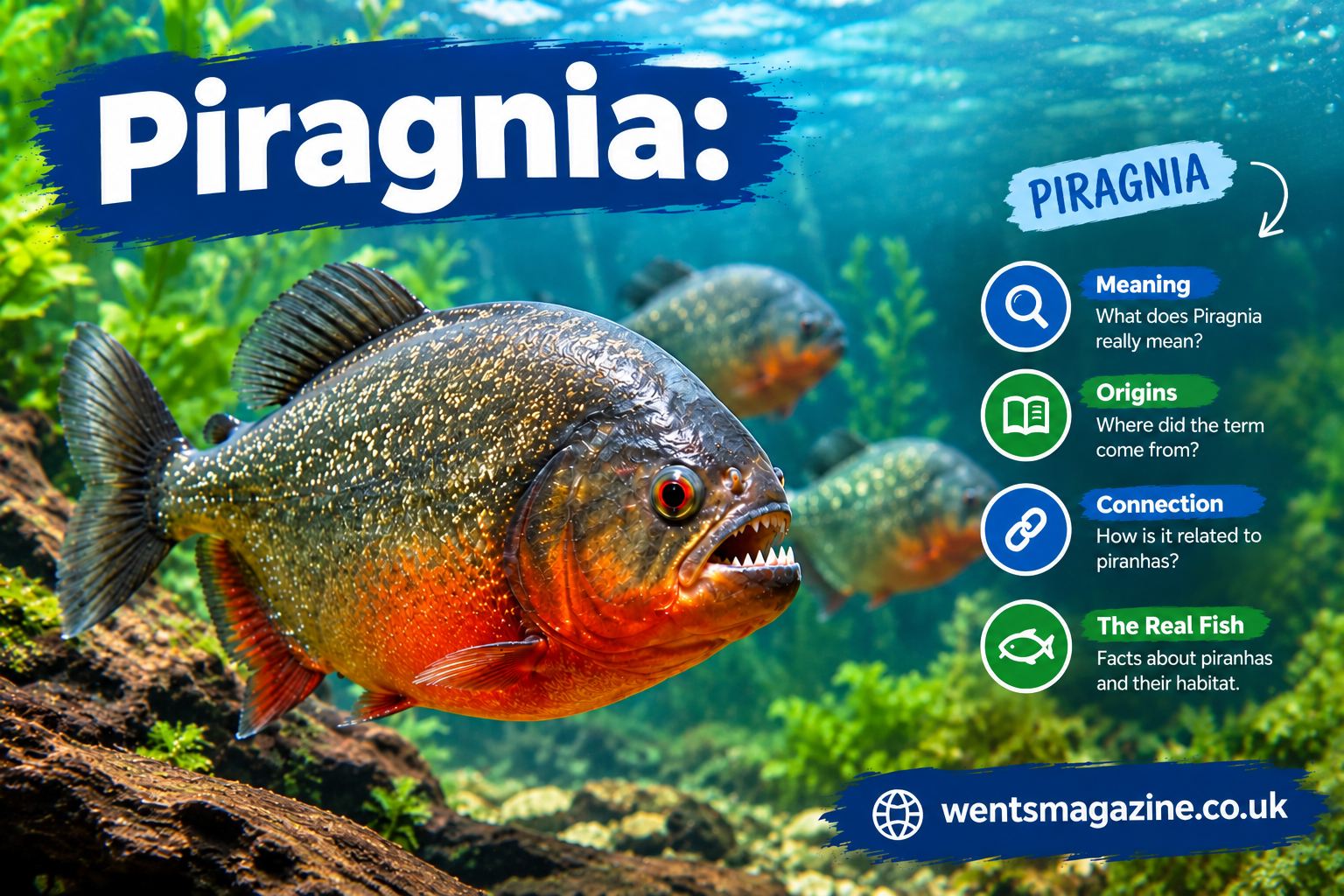
The word Piragnia can be confusing when it first appears in a search. It looks like the name of a particular animal, and its spelling is close to “piranha,” a well-known group of freshwater fish. That similarity has led some online pages to describe Piragnia as a separate fish, a rare species, or even a newly discovered aquatic predator.
The available evidence does not support those descriptions. Piragnia is generally used online as a spelling variation or mistaken form of piranha, rather than as an accepted scientific name for a separate fish. Standard fish references identify piranhas within the family Serrasalmidae, while FishBase lists species such as the red piranha, Pygocentrus nattereri, under established scientific classification.
Understanding this distinction is important because internet searches can make an unfamiliar word appear more established than it really is. When a spelling is repeated across websites, social media posts, image captions, and articles, readers may naturally assume that it represents an official term.
What Is Piragnia?
Piragnia is best understood as an informal spelling, alternate rendering, or misspelling associated with the word piranha.
There is no widely accepted scientific fish classification called Piragnia. Searches for the term often lead to articles explaining its connection to piranhas rather than to evidence of a separate animal. Several recent online sources make the same distinction, describing Piragnia as an internet variation of the established term piranha.
That does not mean the search term is meaningless. It tells us something about how people interact with information online. A person may have heard the word piranha pronounced differently, seen an incorrect spelling, or encountered the term in an article that presented it without explanation.
Once that spelling enters search engines, it can generate additional content. Other writers may then repeat it, sometimes without checking whether it has a scientific basis.
For that reason, the most accurate way to discuss Piragnia is to explain the term while using reliable information about the fish it appears to reference.
Piragnia and Piranha Are Not Two Different Fish
One of the biggest sources of confusion is the assumption that the two words identify different animals.
They do not appear to represent two separate recognized fish groups.
Piranhas are freshwater fish belonging to the family Serrasalmidae. FishBase places the red piranha, Pygocentrus nattereri, within the order Characiformes and family Serrasalmidae. Its documented distribution includes parts of the Amazon River basin, Paraguay-Paraná River basin, northeastern Brazilian coastal rivers, and the Essequibo River basin.
This classification is different from simply assigning a common name to a fish found in a particular region. Scientific names provide a consistent way for researchers to identify species regardless of language or local terminology.
So when a page describes “Piragnia fish,” readers should check whether it is actually discussing a piranha. In most cases, that is the explanation.
Why the Confusion Exists
Spelling mistakes are common in online searches. People often type words based on how they sound rather than how they are officially written.
Piranha is not an immediately obvious English spelling for someone encountering the word for the first time. The pronunciation and spelling can lead to alternative versions, particularly when a person has heard the word but never seen it written.
The internet can reinforce such variations.
A user searches for an unfamiliar spelling. A website publishes an article using that spelling. Another website copies or rephrases the information. Search engines then index multiple pages containing the same variation.
Eventually, the repeated term can appear to have a meaning of its own.
That process does not necessarily create a new biological classification. It simply creates a recognizable search phrase.
This is why it is useful to separate search language from scientific language.
What Is a Piranha?
Piranha refers to several species of freshwater fish associated primarily with South America.
One well-known example is the red-bellied piranha, Pygocentrus nattereri. The Smithsonian’s National Zoo identifies it as a member of the family Serrasalmidae and describes it as native to the Amazon River basin.
The red-bellied piranha has a compact body, a rounded profile, powerful jaws, and sharp triangular teeth. Its lower jaw contains strong muscles that allow the fish to deliver a substantial bite.
These physical features explain much of the fish’s reputation.
However, having powerful teeth does not mean that piranhas spend their lives attacking large animals. Their natural feeding behaviour is more varied.
Where Piranhas Live
Piranhas are freshwater fish associated with river systems, floodplain environments, lakes, streams, and other connected waterways in South America.
The red-bellied piranha is documented across large parts of the Amazon basin and other South American river systems. FishBase records its distribution across the Amazon River basin, Paraguay-Paraná River basin, northeastern Brazilian coastal rivers, and the Essequibo River basin.
The Smithsonian also describes red-bellied piranhas as inhabitants of both still and moving water in the low-elevation Amazon River basin.
This habitat is important when considering the animal’s behaviour.
A fish living in a complex river system has access to many different food sources. Its diet and activity can change according to water conditions, available prey, age, and time of day.
What Do Piranhas Eat?
The popular image of piranhas often focuses almost entirely on flesh.
Their actual diets are more varied.
FishBase records that adult red piranhas feed on insects, worms, and fish. The Smithsonian notes that red-bellied piranhas eat fish fins, pieces of flesh, small fish, insects, aquatic invertebrates, and occasionally plant material such as ripe fruit.
This variety is important.
Piranhas can act as predators, scavengers, and consumers of other available food. Their role is not limited to attacking large animals.
The ability to feed on different materials gives them flexibility within their environment.
Why Do Piranhas Have Sharp Teeth?
The teeth are one of the defining features of piranhas.
Red-bellied piranhas have triangular teeth that interlock when the jaws close. The Smithsonian describes their teeth as adapted for powerful biting and shearing.
FishBase also notes that their dentition can produce serious bites and that teeth are replaced on alternating sides of the jaw.
This structure is useful for cutting food.
The teeth should therefore be understood as a biological adaptation rather than evidence that the fish is constantly aggressive.
Many animals have specialised teeth or jaws designed for particular diets. Piranhas are one example of how physical structure reflects feeding behaviour.
Are Piranhas Dangerous?
Piranhas can bite, and their teeth can cause serious injury. That fact should not be ignored.
FishBase specifically notes the potential for serious bites, while its species information classifies Pygocentrus nattereri as having a documented threat to humans.
At the same time, popular culture has often presented piranhas as constant human hunters.
That image is much more extreme than the biology suggests.
Smithsonian reporting has examined the long-standing stereotype surrounding piranhas and noted that the fish have been widely misunderstood.
A realistic description is therefore more useful than either extreme. Piranhas possess dangerous teeth and can bite, but they should not automatically be described as relentless man-eating predators.
Why the Man-Eating Reputation Became So Strong
Movies and popular media have played a major role in shaping the public image of piranhas.
Films have repeatedly shown groups of piranhas attacking swimmers and consuming people in dramatic scenes. These portrayals are designed for entertainment, not as biological documentaries.
The Smithsonian has specifically discussed the role of movies in creating the piranha’s fearsome public reputation.
Once a particular image becomes established, it can be difficult to correct.
People who have never encountered the fish may learn about it through films, television, social media, or sensational online videos. As a result, fictional behaviour can become mixed with real information.
This is one reason terms such as Piragnia can attract attention. The unusual spelling is combined with an animal that already has a strong reputation.
Piranhas Are Part of the Ecosystem
Piranhas are not simply dangerous fish waiting for an opportunity to attack.
They occupy a place within freshwater ecosystems.
The Smithsonian describes red-bellied piranhas as important scavengers and notes that they can influence the distribution of other fish species as predators and scavengers.
Their feeding activity contributes to the wider food web.
Like other predators, piranhas interact with prey populations. Like scavengers, they can consume available food material. Their presence is therefore connected to the wider structure of their aquatic environment.
This ecological role is often overlooked when discussions focus only on their teeth.
How Piranhas Behave in Groups
Piranhas are sometimes seen in groups, which has contributed to the idea that they automatically form attack groups.
The reality is more complicated.
The Smithsonian reports that red-bellied piranhas tend to travel in schools of 20 or more individuals.
FishBase also records social hierarchies within small schools for Pygocentrus nattereri.
Group behaviour can have several biological advantages. Fish may benefit from increased awareness of predators, access to food, or social interactions.
Simply seeing a group of piranhas together should not therefore be interpreted as evidence of an imminent attack.
Activity Changes With Age and Time
Piranha behaviour is not identical throughout the animal’s life.
FishBase reports that larger red piranhas tend to feed around dawn and dusk, while smaller individuals can be active during the day.
The Smithsonian similarly notes differences between smaller and larger fish in their feeding activity.
This is another example of why simple descriptions can be misleading.
A species does not necessarily have one fixed behaviour. Age, size, habitat, food availability, and environmental conditions can influence activity.
Physical Size
Piranhas are not enormous river monsters.
The Smithsonian reports that red-bellied piranhas can grow to a little over 30 centimetres and weigh up to about 1.81 kilograms.
FishBase gives a larger recorded maximum length of 50 centimetres for Pygocentrus nattereri.
These measurements show why photographs and films can create a misleading impression.
A close-up image of a piranha’s head can make its teeth appear much larger than they would look in the context of the whole fish.
Why Accurate Naming Matters
Correct naming is more than a technical issue.
When people search for an animal, they want information about a real species, its habitat, behaviour, diet, and conservation status.
If a misspelled term is treated as an independent species without evidence, misinformation can quickly develop.
A reader might believe that Piragnia is a newly discovered fish when the available scientific references are actually describing piranhas.
Using the accepted term makes it easier to locate reliable biological information. Researchers, aquariums, museums, conservation organisations, and scientific databases generally use established taxonomic names and recognised common names.
Piragnia as an Internet Search Term
There is still a legitimate reason to discuss Piragnia.
People are searching for it.
Online publications have increasingly produced articles attempting to explain whether the term represents a real animal or a variation of piranha.
This makes the word an interesting example of digital language.
Search engines do not decide whether a term is scientifically valid. They index words that appear online and connect them with pages that use those words.
As more content is created around an unusual spelling, the term can become more visible.
That visibility should not be confused with scientific recognition.
How to Research the Term Properly
Someone researching Piragnia should begin by checking whether the term appears in established biological databases.
The next step is to search for the related word piranha and compare the information.
FishBase is particularly useful for species-level information because it provides classification, distribution, habitat, biology, and other scientific details. Its entry for Pygocentrus nattereri identifies the fish as red piranha and places it within Serrasalmidae.
The Smithsonian National Zoo provides another useful reference for physical characteristics, diet, habitat, behaviour, and conservation information about red-bellied piranhas.
Using these sources gives readers a stronger foundation than relying solely on repeated blog descriptions.
Final Thoughts
Piragnia is best understood as an online spelling variation or mistaken form associated with piranha, not as a separately established fish species.
The real animal behind the confusion is the piranha, a group of freshwater fish associated with South American river systems. Species such as the red-bellied piranha have specialised teeth, varied diets, social behaviour, and an important role within their aquatic environments.
The distinction between the two terms matters because repeated online usage can make an unfamiliar spelling look official. A word appearing on many websites does not automatically make it a scientific classification.
For anyone searching for Piragnia, the most useful approach is therefore simple: understand the spelling, then look at the established biology of piranhas.
That provides a clearer picture of the fish, its natural habitat, feeding behaviour, physical characteristics, and reputation. It also shows how an ordinary spelling variation can become a subject of online curiosity without representing a new species.